
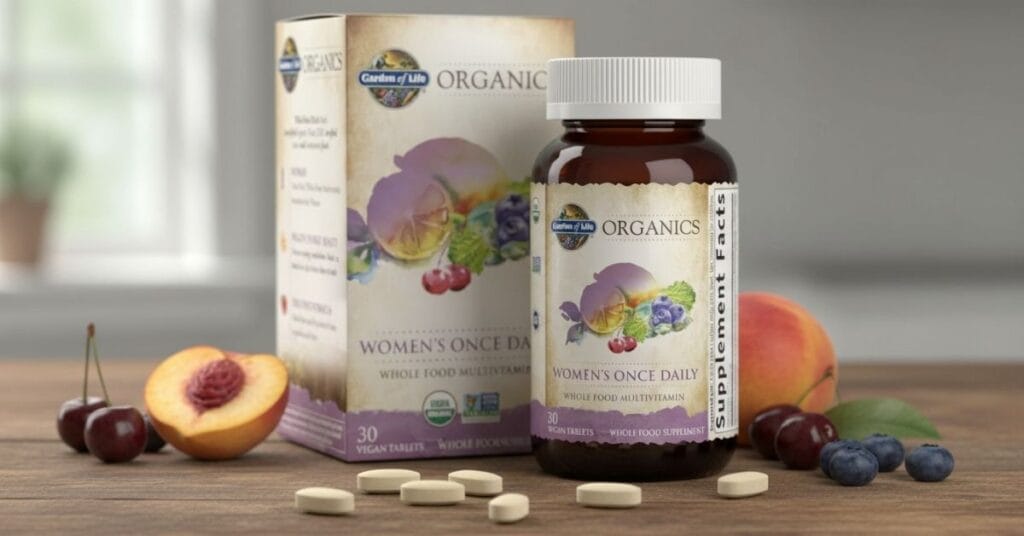
Garden of Life mykind Organics Women’s Once Daily is a certified organic, whole-food–based multivitamin formulated for adult women seeking daily micronutrient coverage in a convenient once-daily tablet. It combines essential vitamins like D3, K, and methylated B12 with an organic fruit and vegetable blend.
While the individual nutrients have established biological roles, there are no published clinical trials evaluating the finished formula itself. Safety considerations include moderate niacin levels that may cause flushing in sensitive individuals and the inclusion of iron, which requires careful storage. For women seeking organic sourcing and simplified daily supplementation, this may represent a reasonable option — provided expectations remain realistic.
👉 If you’re already considering a whole-food multivitamin, reviewing the official formulation details may help clarify whether this approach aligns with your needs.
Many readers prefer checking the source directly before making a decision.
What Is Garden of Life mykind Organics Women’s Once Daily?
This product is a once-daily multivitamin designed specifically for adult women in the United States. It emphasizes:
- Certified organic ingredients
- Whole-food–derived vitamins and minerals
- Vegan-friendly vitamin D3 (from lichen)
- Methylated B12 (methylcobalamin)
- No synthetic binders, artificial colors, or preservatives
- Free from dairy, soy, peanuts, tree nuts, and shellfish ingredients
Unlike many conventional multivitamins that rely primarily on synthetic isolates, this formula positions itself as “food-based,” incorporating an organic fruit and vegetable blend for phytonutrient support.
Its primary differentiator in the crowded U.S. market is organic certification combined with simplified once-daily dosing.
What Problem Does It Claim to Address?
This is not a disease-treatment supplement. Instead, it targets general areas associated with women’s daily nutritional needs:
- Micronutrient adequacy
- Energy metabolism support
- Bone health
- Immune system function
- General wellness maintenance
Why Many Women Consider Multivitamins
Women often turn to multivitamins due to:
- Inconsistent dietary intake
- Busy schedules limiting nutrient diversity
- Fatigue or perceived low energy
- Increased demands during reproductive years
- Concerns about bone density
- Preference for preventative health strategies
For many, a daily multivitamin serves as nutritional “insurance” — not a medical solution, but a consistency tool.
It’s important to emphasize: this product does not treat disease and should not replace diagnostic testing or physician-guided care.
Scientific & Formula Analysis
Vitamin D3 (from Lichen)
Vitamin D3 plays a role in:
- Calcium absorption
- Bone mineralization
- Immune modulation
Plant-derived D3 from lichen makes the formula suitable for vegans. However, optimal dosing depends on individual blood levels (25-hydroxyvitamin D). Without testing, adequacy cannot be assumed.
Vitamin K (from Saccharomyces cerevisiae)
Vitamin K supports:
- Bone metabolism
- Proper blood clotting
Its inclusion alongside vitamin D reflects biological synergy in calcium regulation.
Vitamin B12 (Methylcobalamin)
Methylcobalamin is the bioactive form of B12. It supports:
- Nerve function
- DNA synthesis
- Red blood cell production
This is particularly relevant for vegetarian or plant-forward diets.
Whole-Food Niacin (18.4 mg)
The product contains 18.4 mg of niacin.
Niacin Flush Risk
Niacin may cause:
- Temporary skin redness
- Warmth
- Tingling
- Mild itching
This “niacin flush” is generally harmless but can be uncomfortable. Taking the tablet with food is advisable.
The dosage is close to the adult female RDA (14 mg/day), though individual sensitivity varies.
Organic Food Blend
The formula includes organic botanicals such as:
- Organic Amla
- Organic Moringa
- Organic Holy Basil
- Organic Broccoli, Spinach, Kale
- Organic berries
- Organic Ginger and Garlic
These ingredients provide phytonutrients in whole-food contexts. However:
- Individual milligram quantities are not fully disclosed.
- No clinical trials evaluate the blend as a unified therapeutic formula.
- Inclusion may serve branding differentiation more than measurable clinical impact.
Ingredient-Level vs Product-Level Evidence
This distinction matters.
Ingredient-level evidence:
Individual vitamins have well-documented biological roles.
Product-level evidence:
No published clinical trials evaluate the entire finished formula.
This is common in the supplement industry but important for readers evaluating claims.
Whole-Food vs Synthetic Multivitamins: Does It Matter?
One of the central marketing distinctions of the mykind Organics line is its whole-food positioning. The implication is that nutrients derived from organic food sources may offer superior absorption or biological compatibility compared to synthetic isolates.
From a scientific standpoint, the reality is more nuanced.
For many vitamins (such as B12, vitamin D, and folate), bioavailability depends more on chemical form and dosage than on whether the source is labeled “food-based.” In some cases, synthetic forms are well studied and reliably absorbed.
Whole-food blends may provide additional phytonutrients not present in isolated vitamins. However, unless those compounds are standardized and present in clinically meaningful doses, measurable outcomes may be difficult to demonstrate.
In short, the distinction may matter philosophically and contextually, but strong comparative clinical evidence remains limited. Consumers choosing this formula are often prioritizing sourcing values as much as pharmacological superiority.
What the Formula Lacks
A high-trust evaluation must address limitations.
1. No Full-Formula Clinical Trials
There are no published human studies showing:
- Improved fatigue outcomes
- Enhanced absorption from organic sourcing
- Measurable superiority over synthetic formulas
Claims of improved bioavailability remain largely theoretical without product-specific research.
2. Limited Transparency in Blend Quantities
The organic blend does not specify:
- Standardization
- Active compound concentrations
- Clinically relevant dosing levels
This limits precise evaluation of botanical impact.
3. No Personalization
The formula does not adjust for:
- Perimenopause
- Postmenopause
- Iron status variability
- Thyroid conditions
- Pregnancy
It provides generalized support, not individualized therapy.
👉 For readers comfortable with these limitations, the official website provides full ingredient transparency and availability details.
Reviewing the details directly can support a fully informed decision.
Marketing Claims vs Reality
Searches often include:
- “Garden of Life mykind Organics Women’s Once Daily review 2026”
- “Is it legit or a scam?”
- “Is it FDA approved?”
Let’s clarify.
Is It FDA Approved?
No dietary supplement in the United States is FDA approved before sale.
Under DSHEA:
- Manufacturers ensure safety
- The FDA regulates post-market
- Disease-treatment claims are prohibited
Lack of FDA approval is standard for supplements.
Does It “Work”?
For general micronutrient coverage, a properly formulated multivitamin can help correct mild deficiencies.
It does not treat:
- Hormonal disorders
- Thyroid dysfunction
- Chronic fatigue syndrome
- Severe anemia
Effectiveness depends heavily on baseline nutritional status.
Is It Legit?
There is no evidence suggesting fraud. The ingredient list is transparent and safety warnings are clearly stated.
“Legit” does not equal “clinically proven.” It operates within normal supplement industry standards.
User Complaints & Dissatisfaction Patterns
Common themes include:
Niacin Flush Discomfort
Unexpected flushing can be concerning if not anticipated.
No Noticeable Effect
Multivitamins are not stimulants. Benefits may be subtle.
Mild Digestive Upset
Especially if taken without food.
Expectation Mismatch
Some buyers expect:
- Immediate energy boosts
- Hormonal regulation
- Visible transformation
These expectations are not biologically realistic.
Understanding this reduces misattribution of normal limitations to product failure.
How It Compares to Other Garden of Life Multivitamins
| Feature | mykind Organics Women’s Once Daily | mykind Organics Women’s Multi | Vitamin Code Women |
|---|---|---|---|
| Tablets Per Day | 1 | 2 | 4 capsules |
| Organic Certified | Yes | Yes | No |
| Whole-Food Blend | Yes | Yes | Raw probiotic blend |
| Positioning | Simplicity | Broader coverage | “Raw” formula concept |
Key Distinctions
- Once Daily → Convenience-focused
- Women’s Multi → Higher dosing frequency
- Vitamin Code → Different formulation philosophy
Women prioritizing certified organic sourcing and minimal pill burden may prefer the Once Daily format.
Side Effects & Safety Considerations
Niacin Flush
Temporary, generally harmless.
Iron Warning
Iron-containing supplements must be stored safely away from children.
Who Should Consult a Healthcare Professional?
- Pregnant or nursing women
- Those taking anticoagulants
- Individuals anticipating surgery
- Anyone with chronic medical conditions
When Supplements Are Not Enough
Seek medical evaluation if experiencing:
- Severe fatigue
- Heavy menstrual bleeding
- Unexplained weight changes
- Neurological symptoms
A multivitamin is not a diagnostic tool.
Realistic Timeline for Results
- 2–4 weeks: Possible subtle stabilization
- 8–12 weeks: Correction of mild deficiencies
Results depend on diet, absorption, and baseline status.
Immediate transformation is biologically implausible.
Who Is This Multivitamin Most Likely For?
Garden of Life mykind Organics Women’s Once Daily is unlikely to appeal to women looking for dramatic or rapid changes. Instead, it may be better suited for:
- Women who prioritize certified organic sourcing in other areas of their lifestyle
- Those seeking a simplified once-daily format
- Individuals wanting baseline micronutrient coverage rather than high-potency dosing
- Women with generally balanced diets who want consistency rather than correction
It may also resonate with consumers who prefer aligning supplementation with a broader “whole-food” philosophy.
Conversely, women seeking targeted therapeutic support, high-dose correction, or condition-specific interventions may require a more personalized or clinically directed approach.
Pros and Cons
Pros
- Certified organic
- Methylated B12
- Vegan D3
- Transparent safety labeling
- Once-daily convenience
Cons
- No product-level clinical trials
- Niacin flush risk
- Limited botanical dosage transparency
- Not personalized
Is It Worth the Premium Price?
Certified organic multivitamins typically carry a higher price point than conventional synthetic alternatives. The cost difference reflects:
- Organic ingredient sourcing
- Third-party certifications
- Brand positioning
- Manufacturing standards
The practical question becomes whether the premium aligns with personal priorities.
For women who value organic certification and whole-food labeling, the higher cost may feel justified. For others primarily seeking cost-effective micronutrient coverage, a well-formulated conventional multivitamin may provide similar baseline nutritional support at a lower price.
The value proposition, therefore, is less about dramatic performance differences and more about philosophical alignment.
This is a lifestyle-aligned multivitamin — not a clinically differentiated one.
For consumers prioritizing certified organic sourcing, ingredient transparency, and simplified dosing, the premium may feel reasonable. For those focused primarily on measurable clinical superiority or budget efficiency, alternatives may offer comparable foundational coverage at a lower cost.refore, is less about dramatic performance differences and more about alignment with sourcing preferences and lifestyle philosophy.
Pricing & Availability
Positioned as a premium organic multivitamin, pricing reflects:
- Certified organic sourcing
- Brand reputation
- Specialty manufacturing
It is commonly sold online.
👉Readers may verify current pricing and formulation details on the official website to compare with other daily multivitamins.
This can help confirm availability and package options before deciding.
Final Verdict
In this 2026 review, Garden of Life mykind Organics Women’s Once Daily presents as a well-formulated, responsibly labeled, organic-focused multivitamin designed primarily for convenience and baseline nutritional coverage.
It is not FDA approved — which is standard for supplements.
It lacks full-formula clinical trials — also common in the industry.
Its ingredient choices are biologically plausible and appropriately dosed for general support.
Best suited for:
- Women prioritizing certified organic sourcing
- Those preferring once-daily simplicity
- Individuals seeking foundational micronutrient coverage
Not ideal for:
- Treating diagnosed medical conditions
- Replacing laboratory-guided care
- Expecting rapid or transformative results
For readers who understand these boundaries and value sourcing philosophy alongside functionality, this may represent a reasonable premium multivitamin option within its category.
FAQ
Is Garden of Life mykind Organics Women’s Once Daily legit or a scam?
It appears to be a legitimate dietary supplement with transparent labeling and safety disclosures. However, no full-formula clinical trials have evaluated the finished product.
Is it FDA approved?
No. Like most supplements in the U.S., it is not FDA approved before sale but is regulated post-market under DSHEA.
How long does it take to work?
Typically 4–12 weeks for subtle improvements, depending on baseline nutrient status and overall health.
Are there side effects?
Possible niacin flush and mild digestive discomfort if taken without food.
Is there research on the full formula?
No published clinical trials evaluate the complete formula as a unified product.
Can it be purchased on Amazon?
Availability varies by seller. Some consumers prefer official or verified sources for authenticity
This review was written from an independent, evidence-aware perspective to help readers make informed decisions in a supplement market that often prioritizes marketing over clarity.