
By Laura Collins | Updated September 2026 | 14 min read
Affiliate disclosure: This page contains affiliate links — we may earn a commission at no extra cost to you. Medical disclaimer: Not medical advice; consult an eye doctor about any vision changes — these can have serious underlying causes a supplement cannot address.
Quick answer: iGenics contains real, research-backed ingredients — the full AREDS-2 formula plus Ginkgo, Bilberry, and Saffron — but its marketing uses an invented medical term and a fabricated patient story, so evaluate the ingredients separately from the sales narrative.
Quick Verdict
- ✓ iGenics contains 12 genuinely well-known eye-health ingredients, including the full AREDS-2 formula (Lutein, Zeaxanthin, Vitamins C/E, Zinc, Copper) at reasonable doses
- ✓ The Ginkgo+Bilberry glaucoma citation is a real, published study — but it’s a retrospective chart review, not a controlled trial, and the specific “30% improvement” figure isn’t what the actual paper reports
- ✓ Serious concern: the sales page invents a non-standard medical term (“CPE”), builds the entire pitch around a fabricated patient story and religious framing, and cites inconsistent customer numbers on the same page
iGenics is marketed through one of the most elaborate sales narratives we’ve encountered — a fictional doctor, a dramatic car-crash story, biblical scripture, and a made-up medical term presented as established science. Underneath all of that is a real, disclosed 12-ingredient formula. We separated the two, checked the actual studies behind the claims, and confirmed current pricing.
At a Glance
| Product | iGenics |
| Category | Eye & vision health capsule |
| Ingredients | Ginkgo Biloba, Bilberry (480mg), Saffron (20mg), AREDS-2 formula, Turmeric (350mg), BioPerine |
| Manufacturer | Science Genics |
| Price | $49–$69 per bottle depending on package |
| Guarantee | 180 days (confirmed) |
What Is iGenics?
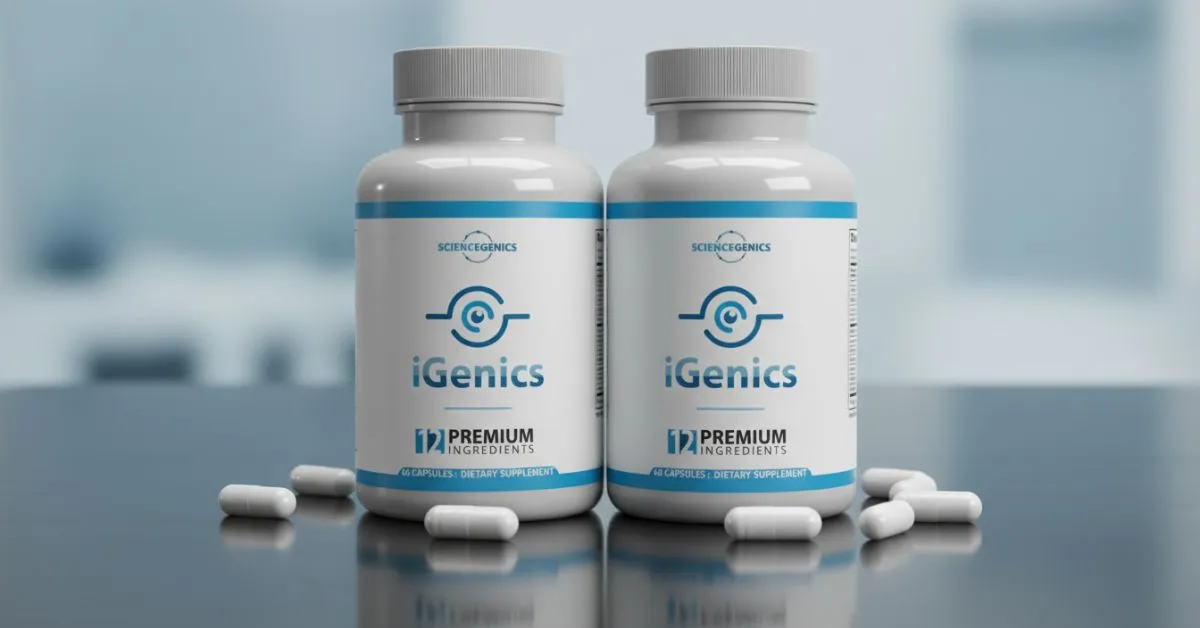
iGenics is a capsule supplement combining the full AREDS-2 nutrient set (the research-backed formula for age-related eye health) with additional botanicals — Ginkgo Biloba, Bilberry, Saffron, Turmeric — plus BioPerine for absorption. Taken as 2 capsules daily.
What it is NOT:
- A treatment for AMD, glaucoma, cataracts, or any diagnosed eye condition
- A replacement for regular eye exams — vision changes can signal serious conditions requiring prompt medical evaluation
- Backed by the “12-second morning ritual” framing or dramatic claims made in its marketing
⚠️ About the Marketing — Read This Before Anything Else
This is unusual enough that it needs its own section.
The sales page presents a fictional-sounding narrative: a doctor character with a dramatic patient story involving a car accident, an invented medical term called “CPE” (Chronic Proinflammatory Environment) presented as established science, extended biblical scripture connecting the product to the “Tree of Life,” and claims that “eye industry billionaires” are trying to shut the website down.
None of this is standard, verifiable medical terminology or typical practice for legitimate health communication. “CPE” as used on this page does not appear in peer-reviewed ophthalmology literature as an established diagnostic concept. We also found the page cites two different customer counts — “47,589+ reviews” in one section and “22,436 people” in another — an internal inconsistency worth noting.
This doesn’t necessarily mean the ingredients themselves are fake — we verified several real studies below — but the packaging around them uses persuasion techniques (fear, urgency, religious appeal, conspiracy framing) that go well beyond typical, honest supplement marketing. Approach the dramatic claims with real skepticism.
The 12 Ingredients — What’s Actually in It
Part of the well-established AREDS-2 formula, the only nutrients naturally concentrated in the eye itself. Genuine published research (including a JAMA-affiliated study) connects adequate intake to reduced AMD risk. Doses here are consistent with AREDS-2 research levels.
The remaining AREDS-2 nutrients, with genuine, well-documented research for slowing AMD progression in people who already have intermediate-stage disease — the population the original AREDS studies actually tested.
A real 2012 study found meaningful visual field improvement in glaucoma patients using this combination — but it was a retrospective chart review, not a controlled trial, and the marketing’s “30% improvement” figure isn’t what the actual paper reports. Broader bilberry research for general vision/night vision is genuinely mixed — several rigorous double-blind trials found no benefit.
Real published research supports saffron’s antioxidant relevance to AMD, with some clinical trials showing benefit. A genuinely reasonable inclusion at this dose.
Turmeric’s curcumin has general anti-inflammatory research with some eye-relevant animal data. BioPerine is a standard, well-evidenced absorption enhancer for the other ingredients.
Who Should — and Shouldn’t — Use This
- Should see an eye doctor first, not a supplement: Anyone with new or worsening vision changes, especially sudden onset — this can indicate a serious condition requiring prompt treatment, and no supplement should delay that evaluation
- Might consider, with realistic expectations: Adults with diagnosed intermediate AMD who’ve discussed AREDS-2-style supplementation with their eye doctor
- Should be skeptical of: Any claim that this product replaces glasses, contacts, or treats diagnosed eye disease — no ingredient in this or any supplement does that
Side Effects & Safety
Generally well-tolerated based on the ingredient profile. Ginkgo Biloba has mild blood-thinning properties — consult your doctor if you’re on blood thinners or have a bleeding disorder.
Pricing & Where to Buy
1 Bottle
30 Day Supply
$149 $69
per bottle
+ $9.99 shipping
180-Day Guarantee
3 Bottles
90 Day Supply
$447 $59
per bottle
Total: $177
✓ Free Shipping · 2 Bonuses
180-Day Guarantee
6 Bottles
180 Day Supply
$894 $49
per bottle
Total: $294
✓ Free Shipping · 3 Bonuses
180-Day Guarantee
Check Current Pricing — Official Website →
On the 180-day guarantee: this is genuinely confirmed and generous. On urgency claims (“only 50 customers,” limited stock): treat these as standard sales page tactics rather than literal scarcity — this pattern is common across similar marketing funnels and isn’t something we can independently verify either way.
Pros & Cons
Strengths
- Full AREDS-2 formula included at research-aligned doses
- All 12 ingredients named, not a hidden blend
- Ginkgo+Bilberry glaucoma citation is a real, published study
- Genuinely generous 180-day guarantee
Drawbacks
- “CPE” is an invented term, not real medical terminology
- Marketing uses a fabricated doctor/patient narrative and religious appeals
- Cited “30% improvement” statistic doesn’t match the actual source study
- Inconsistent customer counts on the same page (47,589 vs. 22,436)
- Bilberry’s broader vision evidence is genuinely mixed, not settled
Final Verdict
Strip away the marketing, and iGenics contains a genuinely reasonable ingredient list — the complete AREDS-2 formula at research-aligned doses, plus Ginkgo, Bilberry, Saffron, and Turmeric with real, if more modest than advertised, supporting research. The 180-day guarantee is a real, generous safety net.
The marketing itself is the significant problem here — an invented pseudo-medical term, a fabricated doctor-and-patient narrative, religious manipulation, conspiracy-style urgency, and a statistic that doesn’t match its own cited source. This is a case where evaluating the product means deliberately separating legitimate ingredients from a sales approach we cannot recommend trusting at face value.
Our rating: 2.5 / 5 — Real ingredients undermined by manipulative marketing; approach with significant skepticism
Considering iGenics?
Real AREDS-2 ingredients and a 180-day guarantee — evaluate the product itself, not the sales narrative.
Visit the Official Website →Frequently Asked Questions
Is “CPE” (Chronic Proinflammatory Environment) a real medical condition? No — this specific term as used in iGenics’ marketing is not established ophthalmology terminology. Inflammation and oxidative stress genuinely do play roles in eye aging, but “CPE” itself appears to be marketing language, not a recognized diagnosis.
Does iGenics really work in 7 days? There’s no evidence supporting rapid, dramatic vision changes from any supplement in that timeframe. Supplements for eye health, when they help at all, typically require weeks to months of consistent use.
Is the doctor story real? We cannot verify the narrative presented — the framing follows a common marketing pattern (fictional or composite doctor persona with a dramatic patient story) rather than typical, verifiable medical case reporting.
Should I trust the “30% improvement” claim? The underlying study is real, but it reports results in different units (logMAR visual acuity), not a 30% figure. Treat specific statistics in the marketing with caution and refer to the actual published research when possible.
What’s the real guarantee? 180 days, confirmed on the official order page — genuinely one of the longer guarantee windows we’ve documented.
References
- Shim SH, Kim JM, Choi CY, Kim CY, Park KH. Ginkgo biloba extract and bilberry anthocyanins improve visual function in patients with normal tension glaucoma. Journal of Medicinal Food, 2012. <a href=”https://pubmed.ncbi.nlm.nih.gov/22870951/” target=”_blank” rel=”noopener noreferrer”>PMID: 22870951</a>
- Age-Related Eye Disease Study Research Group. AREDS2 supplementation and progression of age-related macular degeneration. JAMA, published research on Lutein/Zeaxanthin and AMD risk.
- Bilberry’s therapeutic uses for night vision — mixed double-blind trial results. EBSCO Research Starters, Complementary and Alternative Medicine.

Laura Collins
Editorial direction and review for Wellness Balance Pro. We verified the underlying study behind the product’s central marketing claim and found it doesn’t fully match how it’s presented — this review separates the real ingredient science from the sales narrative.
⚠️ Medical Disclaimer: This content is for informational purposes only and is not intended as medical advice. Always consult an eye doctor about any vision changes.
Affiliate Disclosure: This page contains affiliate links. If you purchase through our link, we may earn a commission at no additional cost to you. This does not influence our assessment.