
By Laura Collins | Updated July 2026 | 11 min read
Affiliate disclosure: This page contains affiliate links. If you purchase through our links we may earn a small commission at no extra cost to you.
Medical disclaimer: This content is for informational purposes only. Always consult your doctor before starting any supplement.
Our Editorial Process: Every ingredient below is cross-referenced against published clinical studies. Where evidence is strong, we say so. Where it’s limited or the dosage isn’t verifiable, we say that too. No ingredient gets a pass just because it sounds good.
If you’ve already decided Yu Sleep looks promising and you want to know exactly what’s in it — this article breaks it down ingredient by ingredient, in plain English.
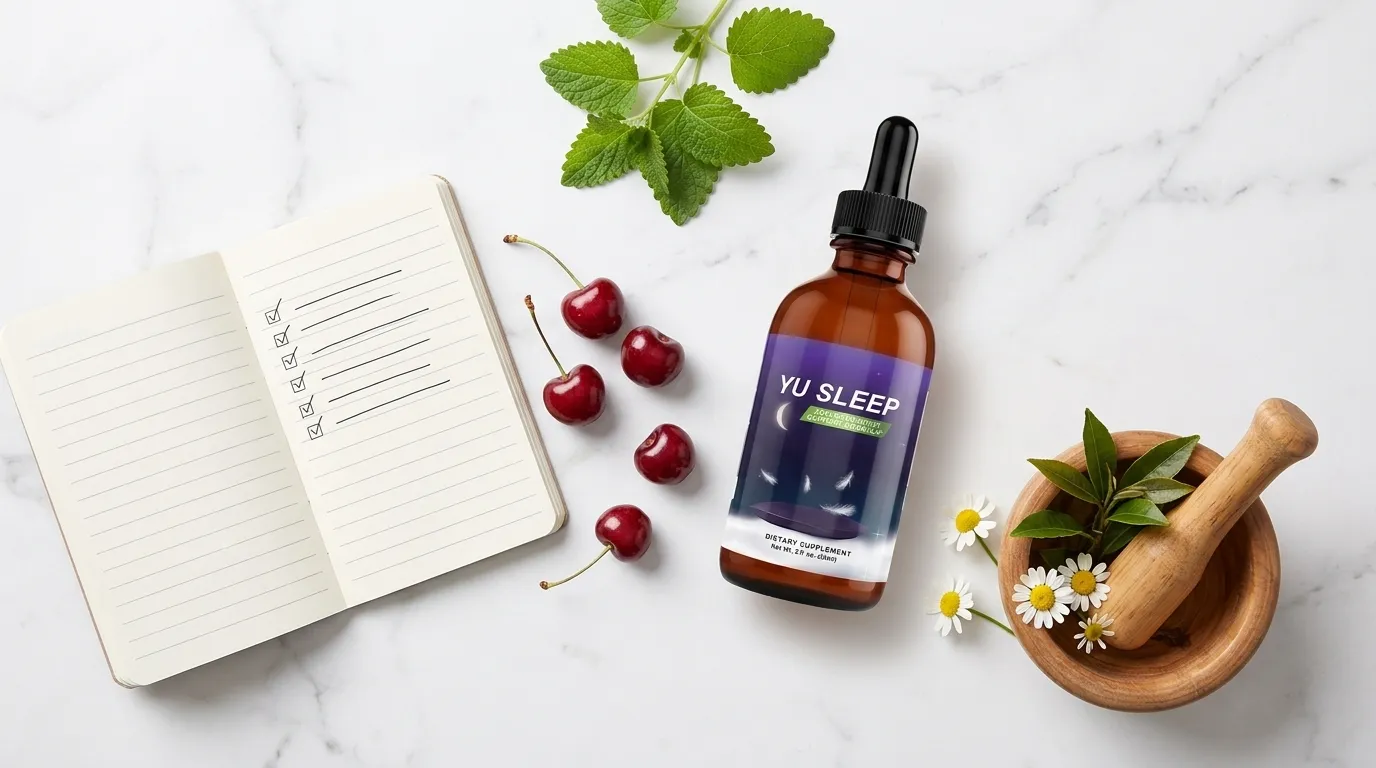
Yu Sleep contains 9 active sleep-supporting ingredients. Three are listed individually with their dosages on the label. The remaining six are grouped in a 637mg proprietary blend — meaning you know what’s in it, but not exactly how much of each.
We’ll cover what that means for you at the end. First — the ingredients themselves.
👉 Visit the Official Yu Sleep Website
The Ingredients With Disclosed Dosages
Melatonin — 0.9mg
What it does: Melatonin is the hormone your brain naturally releases as it gets dark outside — it’s your body’s “time to sleep” signal. Yu Sleep uses 0.9mg, which is significantly lower than the 5 to 10mg found in most sleep gummies and pills.
Why the low dose is actually better:
Most people assume more melatonin = better sleep. Research increasingly shows the opposite. Melatonin is a signal, not a sedative — it tells your brain to prepare for sleep, it doesn’t knock you out. High doses overwhelm the signal and often cause next-morning grogginess while suppressing your body’s own production over time.
Research confirms that low-dose melatonin is effective for sleep onset — and a systematic review found no meaningful advantage to higher doses for most people.
Yu Sleep’s 0.9mg is close to what your body naturally produces — which is why most users report waking up without that heavy, groggy feeling.
Vitamin B6 — 0.5mg (as Pyridoxal-5-Phosphate)
What it does: B6 is a critical cofactor in the pathway that converts 5-HTP into serotonin, and serotonin into melatonin. Without adequate B6, even if your body has all the right precursors, it can’t efficiently produce the sleep hormones it needs.
The active form used here — Pyridoxal-5-Phosphate — is more bioavailable than standard B6, meaning more of it actually gets used.
Why it matters: Research shows that B6 affects dream recall and sleep quality. More practically — it’s the reason Yu Sleep’s 5-HTP works more efficiently than 5-HTP alone.
Vitamin B2 — 0.5mg (as Riboflavin-5-Phosphate)
What it does: Like B6, Riboflavin supports the neurotransmitter pathways involved in sleep. It also plays a role in circadian rhythm regulation — your body’s internal clock that determines when you feel sleepy and when you feel awake.
Again, the active form (Riboflavin-5-Phosphate) is used — better absorbed than standard riboflavin.
The Proprietary Blend — 637mg Total
The remaining six ingredients are grouped together at 637mg. You know they’re in there — you just can’t verify the exact amount of each.
Here’s what each one does, and why it’s included:
Red Tart Cherry Juice Concentrate
What it does: Tart cherries are one of the few natural food sources of melatonin — they literally contain the same hormone your brain produces at night. They also contain anti-inflammatory compounds that independently support sleep quality.
What the research shows: A 2012 study found tart cherry juice increased total sleep time and sleep efficiency. A follow-up study specifically in older adults with insomnia found meaningful improvements in sleep duration.
In plain English: Your grandmother wasn’t wrong when she said drink cherry juice before bed. The science actually backs this one.
Magnesium Glycinate
What it does: Magnesium is one of the most important minerals for sleep — and one of the most common deficiencies in American adults. It supports muscle relaxation, activates the calming side of your nervous system, and supports the GABA receptors responsible for deep sleep.
Magnesium Glycinate is the most bioavailable and stomach-friendly form — it absorbs significantly better than the cheap magnesium oxide found in many supplements.
Why it matters: If you often feel like you slept but didn’t actually recover — like you were half-awake all night — low magnesium could be why. Many people notice the deepest improvements from Yu Sleep are specifically tied to this ingredient.
Honest note: Magnesium Glycinate alone (300 to 400mg) is actually a worthy standalone sleep supplement if budget is a concern. Yu Sleep includes it as one piece of a larger formula — but it’s genuinely one of the formula’s strongest ingredients.
Apigenin
What it does: Apigenin is the compound in chamomile that gives chamomile tea its calming effect. It binds to the same GABA receptors in the brain that prescription sleep medications target — but far more gently, and without any dependency risk.
This is why people have been drinking chamomile tea before bed for centuries. There’s real science behind it.
What the research shows: Apigenin reduces the time it takes to fall asleep and decreases restlessness during the night. Early human research is promising, with more studies ongoing.
In plain English: Think of apigenin as chamomile tea in concentrated form — except concentrated enough to actually do something.
Lemon Balm Extract
What it does: Lemon Balm is specifically powerful for the 3 AM wake-up problem — and here’s why.
That early-morning waking is driven by a cortisol spike. Cortisol is your stress hormone, and it starts rising in the early hours to prepare your body to wake up. In people who are stressed or have disrupted sleep architecture, this spike happens too early and too strongly — jolting them awake at 3 AM fully alert when they should still be asleep.
Lemon Balm inhibits the enzyme that breaks down GABA — keeping more of the calming neurotransmitter available in your brain through the night, which reduces that early cortisol spike.
Research support: Multiple studies link Lemon Balm to reduced anxiety, improved sleep quality, and reduced restlessness. It works partly through the GABA system and partly through direct cortisol modulation.
5-HTP (from Griffonia Seed Extract)
What it does: 5-HTP is a building block your body uses to make serotonin — which then gets converted into melatonin with the help of B6 and B2. Instead of adding external melatonin, 5-HTP helps your body produce more of its own.
Think of it this way: external melatonin is borrowing from someone else. 5-HTP is refilling your own tank.
What the research shows: A 2024 clinical trial found 5-HTP supplementation improved sleep quality in older adults. The mechanism — supporting the serotonin-melatonin conversion pathway — is well-established.
The safety warning you need to know: If you take antidepressants (SSRIs like Prozac or Lexapro, SNRIs, or MAOIs), 5-HTP can cause dangerous interactions by raising serotonin levels too high. This is called serotonin syndrome. It’s rare but serious. Always consult your doctor before taking Yu Sleep if you take any of these medications. This isn’t a legal disclaimer — it’s a real clinical concern.
L-Theanine
What it does: L-Theanine is an amino acid found naturally in green tea. During the day, it creates calm, focused alertness — that relaxed-but-sharp feeling you get from tea versus coffee. At night, that same calming effect helps quiet the mental chatter that keeps you lying awake.
What the research shows: A 2025 systematic review of 19 studies found L-theanine supplementation is a safe and effective way to support healthy sleep in adults.
When combined with GABA — which it is in this formula — the effect is amplified. A 2019 clinical study found the GABA and L-Theanine combination reduced time to fall asleep by up to 20% and increased sleep duration by up to 87% compared to either ingredient alone.
In plain English: If your problem is a racing mind at 11 PM when your body is exhausted, this is specifically what addresses that.
GABA
What it does: GABA is your brain’s natural “calm down” signal. It tells overactive neurons to slow down — the neurological equivalent of hitting a brake pedal on a racing mind.
The honest caveat: Regular oral GABA in capsule form struggles to cross from the bloodstream into the brain. This is actually why Yu Sleep’s nano-enhanced sublingual delivery format matters specifically for GABA — the nano-emulsification and under-tongue absorption are designed to improve how much gets where it needs to go.
Independent verification of how much this helps for GABA specifically isn’t publicly available. But research on oral GABA suggests it may also work through the gut-brain axis — a separate pathway that doesn’t require crossing the blood-brain barrier.
How All 9 Ingredients Work Together
This is what makes Yu Sleep genuinely different from just taking melatonin:
Within 15–30 minutes of taking it: GABA and L-Theanine begin quieting overactive brain activity. Apigenin starts binding to calming receptors. You start to feel noticeably more relaxed without feeling sedated.
As you fall asleep: Low-dose melatonin and Tart Cherry signal your circadian rhythm that it’s sleep time. 5-HTP and B6 support serotonin production for sleep quality throughout the night.
During the night: Magnesium Glycinate supports the deeper stages of sleep — the restorative phases where physical healing actually happens. Lemon Balm keeps cortisol from spiking too early and jolting you awake at 3 AM.
In the morning: Because nothing in the formula is a sedative, and because the melatonin dose is calibrated to work with your natural production rather than overwhelm it, most users wake up without grogginess.
The Proprietary Blend — What It Means for You
Yu Sleep’s proprietary blend (637mg for 6 ingredients) means you can verify what is in it but not exactly how much of each ingredient.
Why this matters: Clinical studies on individual ingredients typically use specific doses. For example, studies on L-Theanine for sleep use 200 to 400mg. You can’t confirm from the label alone whether Yu Sleep’s blend includes enough of each ingredient to match those studied doses.
Why it doesn’t automatically mean the formula is weak: Many effective supplement companies use proprietary blends to protect their formulations. And user feedback — while anecdotal — does suggest the formula produces real effects for most people who use it consistently.
The practical takeaway: You’re trusting the formula based on the ingredient quality, the published reference list (which holds up well), and real-world results — not dose verification. That’s a reasonable position for a natural supplement, but it’s worth knowing going in.
👉 Check Current Pricing — Official Yu Sleep Website
Who Benefits Most From This Ingredient Profile
Based on what each ingredient targets:
Most likely to benefit:
- Adults who wake up at 3 AM and can’t get back to sleep — Lemon Balm and Magnesium Glycinate specifically address this
- People with a racing mind at bedtime — GABA, L-Theanine, and Apigenin target this specifically
- Anyone who’s felt groggy from high-dose melatonin — the 0.9mg dose avoids this
- People with magnesium deficiency (common) — Magnesium Glycinate addresses the most overlooked cause of poor sleep
Less likely to see dramatic results:
- People on antidepressants who haven’t cleared it with their doctor — 5-HTP interaction is real
- People with severe clinical insomnia requiring medical treatment
- Anyone who needs exact dosage verification before supplementing
👉 Try Yu Sleep Risk-Free — 60-Day Guarantee
Frequently Asked Questions About Yu Sleep Ingredients
Does Yu Sleep contain melatonin? Yes — 0.9mg per serving. This is significantly lower than most sleep supplements (5 to 10mg). The low dose is intentional — it works with your body’s natural signal rather than overwhelming it.
Does Yu Sleep contain caffeine? No — none of the 9 ingredients contain caffeine. Yu Sleep is stimulant-free.
Is Yu Sleep gluten-free and non-GMO? Yes — the official formula is gluten-free, non-GMO, and soy-free.
Why does Yu Sleep use a proprietary blend? The six ingredients in the 637mg blend are listed but not individually dosed. This is standard practice in the supplement industry to protect formulation details. The total blend amount is disclosed.
Can I take Yu Sleep with other supplements? For most common supplements (Vitamin D, Omega-3, B-complex), yes. Be cautious about doubling up if you already take standalone 5-HTP, L-Theanine, or GABA separately — you could exceed intended doses. If you take any prescription medication, ask your doctor first.
Is 5-HTP safe? For healthy adults not on serotonin-affecting medications — yes, with an excellent safety record at supplemental doses. For people on SSRIs, SNRIs, or MAOIs — no, without medical supervision. This is the most important safety consideration in the entire formula.
👉 Order Yu Sleep from the Official Website
Read More in the Yu Sleep Cluster
→ Yu Sleep Review (2026): Full Honest Assessment
→ Yu Sleep Scam or Legit? Real Reviews & Complaints
→ Yu Sleep Side Effects: Is It Safe? (2026)
→ Where to Buy Yu Sleep (2026): Official Site & Price
→ How Sleep Quality Impacts Blood Sugar Levels
→ GlucoTrust Review: The Sleep + Blood Sugar Supplement
References
¹ Ferracioli-Oda E, et al. “Meta-analysis: melatonin for the treatment of primary sleep disorders.” PLOS ONE, 2013. PMID: 23691095
² Howatson G, et al. “Effect of tart cherry juice on melatonin levels and enhanced sleep quality.” European Journal of Nutrition, 2012. PMID: 22038497
³ Pigeon WR, et al. “Pilot study of tart cherry juice for insomnia in older adults.” Journal of Medicinal Food, 2010. PMID: 28901958
⁴ Kim S, et al. “GABA and l-theanine mixture decreases sleep latency and improves NREM sleep.” Pharmaceutical Biology, 2019. doi: 10.1080/13880209.2018.1557698
⁵ Sutanto CN, et al. “The impact of 5-hydroxytryptophan supplementation on sleep quality.” Clinical Nutrition, 2024. PMID: 38309227
⁶ Nobre AC, et al. “L-theanine and its effect on mental state.” Asia Pacific Journal of Clinical Nutrition, 2008. PMID: 25759004
⁷ Byun JI, et al. “Effects of Oral GABA Administration on Stress and Sleep.” Biomedicines, 2021. PMID: 33041752
⁸ Ebben MR, Lequerica A, Spielman A. “Effects of Pyridoxine on Dreaming.” Perceptual and Motor Skills, 2002. PMID: 29665762