

By Laura Collins | Updated July 2026 | 15 min read
Affiliate disclosure: This page contains affiliate links. If you purchase through our links we may earn a small commission at no extra cost to you. This review is based on independent research — not paid placement.
Medical disclaimer: This content is for informational purposes only. Always consult your doctor before starting any supplement.
Our Editorial Process: We researched every ingredient against published clinical literature, audited the 19 references published on GutOptim’s official website against what each source actually shows, and reviewed user feedback patterns across multiple platforms. We disclose both what’s well-evidenced and where the science is thinner.
Quick Summary: GutOptim is a synbiotic gut health supplement combining probiotics, prebiotic fibers, and botanical ingredients to support digestive balance, reduce bloating, and restore gut lining integrity. It contains 10 key ingredients including Lactobacillus acidophilus, konjac glucomannan, aloe vera, and bentonite clay. Backed by a 60-day money-back guarantee. Best results reported after 4–8 weeks of consistent daily use.
If you’ve been struggling with bloating, irregular digestion, low energy, or that constant feeling of heaviness after meals — you’ve probably already tried a few things that didn’t deliver.
Maybe you’ve tried a basic probiotic. Maybe you’ve cut gluten or dairy. Maybe you’ve just accepted that this is how your body works.
This is our honest, research-backed assessment of what GutOptim is, how it works, what’s actually in it, who it’s best for — and who it’s probably not right for. No fluff. No hype. Just what you need to make an informed decision.
Is GutOptim a Scam?
No. GutOptim is a legitimate product manufactured in a GMP-certified facility, sold through BuyGoods, and backed by a genuine 60-day money-back guarantee.
Our reference audit: We reviewed all 19 scientific references published on GutOptim’s official website. About a quarter are genuine primary studies — including a real randomized controlled trial testing clay compounds for IBS symptoms, and an in vitro study on aloe vera and Lactobacillus growth. The majority of the remaining references are health media summaries (Healthline, Medical News Today, ScienceDaily coverage) rather than primary peer-reviewed research. This is common in the supplement industry but worth knowing — we break down exactly which claims have strong backing in our ingredients section below.
The marketing ecosystem around GutOptim online also includes some red flags — fake doctor endorsements and look-alike review pages on unrelated affiliate domains. These aren’t from the real company, but they’re worth knowing about before you buy.
→ GutOptim Scam or Legit? Full Investigation
👉 Check Current Pricing — Official GutOptim Website
What Is GutOptim?
GutOptim is a dietary supplement designed to support comprehensive gut health through a synbiotic formula — a combination of probiotics (live beneficial bacteria), prebiotics (fibers that feed those bacteria), and botanical ingredients that support the gut lining and digestive function.
Unlike basic probiotic supplements that only add bacteria without supporting their survival or the surrounding environment, GutOptim takes a three-layer approach:
- Repopulate — adding beneficial bacterial strains to the gut microbiome
- Feed — providing prebiotic fiber so those bacteria survive and thrive
- Restore — using botanical ingredients to support the gut lining, reduce inflammation, and improve digestive motility
What it is:
- Capsule format — 2 daily
- 10 disclosed ingredients across probiotic, prebiotic, and botanical categories
- GMP-certified manufacturing
- 60-day money-back guarantee
- Sold through BuyGoods
What it is NOT:
- A treatment for diagnosed GI conditions (Crohn’s, ulcerative colitis, celiac, SIBO)
- A fast fix — results build over 4 to 8 weeks
- A replacement for dietary changes
GutOptim Ingredients: What’s Inside and What the Research Shows
For the complete ingredient-by-ingredient breakdown with full citations, see our dedicated guide: → GutOptim Ingredients: Full Breakdown
The short version:
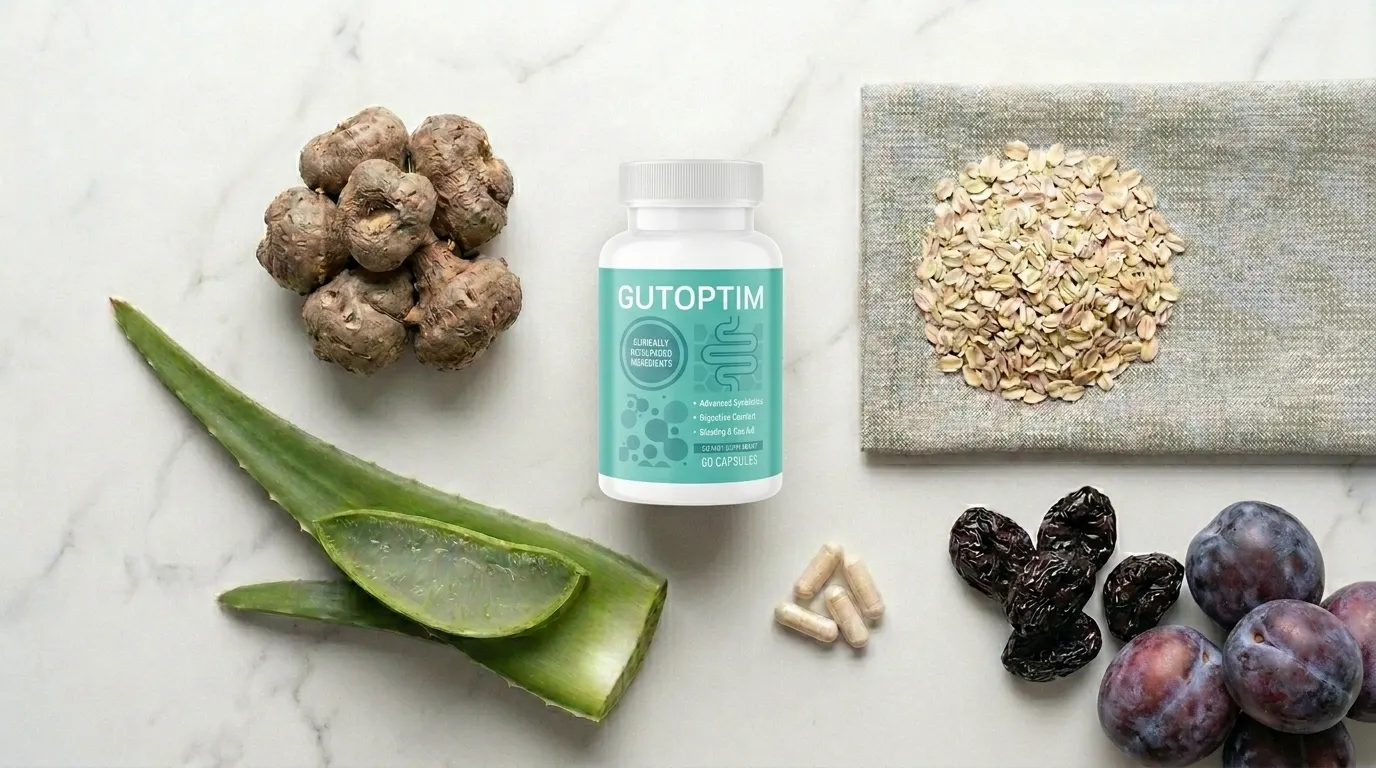
Strong evidence (8 of 10 ingredients): Lactobacillus acidophilus, Konjac Glucomannan, Oat Bran, Aloe Vera, Flaxseed, Apple Pectin, Prune Powder, and Psyllium Husk all have solid human research support for digestive benefits.
Limited human evidence (2 of 10 ingredients): Black Walnut and Bentonite Clay rely primarily on traditional use, animal models, and one relevant RCT (for a related clay compound, not bentonite specifically) rather than robust bentonite-specific human trials.
On bentonite clay specifically: A 2005 randomized controlled trial published in Alimentary Pharmacology & Therapeutics tested beidellitic montmorillonite — a related clay compound, not bentonite itself — and found genuine symptomatic improvement in IBS patients. This is real, relevant evidence for clay-based digestive support broadly, though it doesn’t perfectly map onto GutOptim’s specific bentonite formulation. A separate 2016 study in Scientific Reports found montmorillonite clay adsorbed dietary lipids in animal models — interesting mechanistic support, but again in a different application (lipid excretion, not bloating relief) and in animals, not humans.
On black walnut: Media coverage of research from Louisiana State University’s health sciences center discusses walnuts and gut bacteria changes — this is a genuine research signal, though it points to walnuts broadly rather than black walnut hull extract specifically, and the primary study itself is not directly cited in accessible form.
On aloe vera: A 2012 in vitro study published in Acta Biomedica found aloe vera juice supported Lactobacillus growth in laboratory conditions — real evidence, though in vitro (lab dish) rather than human trial evidence.
How GutOptim Compares to a Basic Probiotic
| Basic Probiotic | GutOptim | |
|---|---|---|
| Probiotic bacteria | Usually 1–2 strains | L. acidophilus + formula support |
| Prebiotic fiber | Usually none | Multiple types (glucomannan, oats, apple pectin, psyllium, flaxseed) |
| Gut lining support | None | Aloe vera, bentonite clay |
| Motility support | None | Prune, psyllium, konjac |
| Antimicrobial support | None | Black walnut |
| Approach | Add bacteria only | Add bacteria + feed them + restore gut environment |
A basic probiotic is like planting seeds in poor soil without watering them. GutOptim prepares the soil, plants the seeds, waters them, and removes the weeds simultaneously.
Who Is GutOptim Best For?
People with frequent bloating and gas — particularly after meals or in the afternoons.
People with irregular bowel movements — whether constipation, loose stools, or alternating between both.
People recovering from antibiotic use — a synbiotic formula is well-suited to restoring balance after antibiotics wipe out gut bacteria indiscriminately.
People who’ve tried basic probiotics without results — often because the gut environment wasn’t prepared to support the bacteria being added.
People with low energy and brain fog alongside digestive symptoms — frequently downstream effects of poor gut health.
People over 40 — digestive enzyme production and gut bacterial diversity both decline naturally with age.
👉 Try GutOptim Risk-Free for 60 Days
Who Might Not See Results
People who aren’t consistent — GutOptim requires daily use for 4 to 8 weeks minimum.
People who don’t make any dietary changes — supplements work best alongside a gut-supportive diet.
People with serious diagnosed medical conditions — GutOptim is a dietary supplement, not a treatment for Crohn’s, ulcerative colitis, celiac disease, or SIBO. Consult your doctor if you have a diagnosed GI condition.
People expecting overnight results — significant microbiome restoration takes longer than 1 to 2 weeks. Quitting early means missing the results that typically arrive later.
What to Expect Week by Week
Weeks 1–2: Some people notice reduced bloating and improved stool consistency fairly quickly. A brief adjustment period (mild gas or loose stools) as gut bacteria shift is normal and typically resolves within 5 to 7 days.
Weeks 3–4: Most consistent users report more regular bowel movements, less post-meal heaviness, and improved energy.
Weeks 5–8: Broader benefits often become apparent — better sleep quality, reduced sugar cravings, more stable mood and energy — reflecting systemic improvements as gut function supports functions beyond digestion.
Beyond 8 weeks: Continued use supports sustained microbial diversity for long-term gut health.
Dosage and How to Take It
Recommended dose: Two capsules daily with a large glass of water, ideally before breakfast.
Taking it before breakfast allows the prebiotic fibers to reach your gut before the day’s food, and the probiotic bacteria begin populating your intestinal tract without immediately competing with food particles.
Important: Increase your water intake when starting. The prebiotic fibers — particularly psyllium and glucomannan — absorb significant water. Inadequate hydration can temporarily worsen constipation rather than improve it.
Safety and Side Effects
GutOptim is formulated with natural ingredients, non-GMO, free from artificial additives, and manufactured in an FDA-compliant, GMP-certified facility.
Most healthy adults tolerate it well. Possible effects during the initial adjustment period (typically the first 5–7 days):
- Mild bloating or gas as gut bacteria begin to shift
- Looser stools in the first few days from the fiber content
- Slight change in bowel frequency as gut motility normalizes
Starting with one capsule daily for the first week before moving to two can reduce adjustment discomfort for sensitive individuals.
Consult your healthcare provider before starting if: you are pregnant or breastfeeding, have a diagnosed digestive condition, take prescription medications, or have known allergies to any listed ingredients (note: black walnut is derived from a tree nut).
For the complete safety breakdown: → GutOptim Side Effects: Full Safety Guide
Pricing and Guarantee
| Package | Supply | Total Price | Shipping |
|---|---|---|---|
| 1 Bottle | 30 days | $69 | Free |
| 3 Bottles | 90 days | $177 ($59/bottle) | Free |
| 6 Bottles | 180 days | $294 ($49/bottle) | Free |
All packages include free shipping — a genuine value advantage compared to many competing supplements that charge shipping on single-bottle orders.
60-day money-back guarantee: Every order is protected for a full 60 days — long enough to properly evaluate results. This is a one-time purchase with no subscription or recurring billing.
Our recommendation: The 3-bottle package for first-time buyers — covers the 90-day window where most meaningful results develop, at a meaningfully better per-bottle price than the single bottle.
For the complete buying guide including where NOT to buy: → Where to Buy GutOptim Safely
👉 See Current Pricing — Official GutOptim Website
Pros and Cons
Pros:
- Synbiotic approach (probiotic + prebiotic + botanical) more comprehensive than basic probiotics
- 8 of 10 ingredients have strong human clinical evidence
- Free shipping on all package sizes
- 60-day money-back guarantee — genuine evaluation window
- One-time purchase, no subscription
- GMP-certified manufacturing
- Addresses both constipation and diarrhea presentations (via psyllium, prune)
Cons:
- 2 of 10 ingredients (black walnut, bentonite clay) rely on limited human evidence
- Official reference list is mostly health media summaries rather than primary research
- Results require 4 to 8 weeks minimum — not fast-acting
- Not appropriate for diagnosed GI conditions
- Fake promotional content exists on third-party sites (not from the real company)
My Overall Assessment
GutOptim earns a genuine recommendation for adults dealing with persistent bloating, irregular digestion, or who’ve tried basic probiotics without lasting results.
The synbiotic approach — pairing probiotics with the prebiotic fiber they need to survive, plus botanical gut-lining support — is more scientifically coherent than the single-strain probiotics most people try first. Eight of the ten ingredients have solid human research behind them, including some genuinely well-studied fibers like psyllium and konjac glucomannan.
The honest limitation: black walnut and bentonite clay lean more on traditional use and animal/in vitro research than robust human trials specific to this application. And the official reference list, while including a few real primary studies, is mostly built from health media summaries rather than peer-reviewed literature — something we think buyers deserve to know.
For adults ready to commit to a consistent 8-week evaluation window, alongside reasonable dietary habits, GutOptim is one of the more thoughtfully formulated synbiotic options we’ve reviewed.
Our rating: 3.5 / 5 — Recommended for persistent digestive discomfort, with realistic expectations about timeline and the evidence tier of a couple of ingredients
👉 Visit the Official GutOptim Website
Frequently Asked Questions
Is GutOptim safe? For most healthy adults — yes. It’s manufactured in a GMP-certified facility with natural ingredients. Consult your doctor if pregnant, nursing, on medication, or managing a diagnosed digestive condition.
How many bottles should I order? The 3-bottle package (90-day supply) is our recommendation for first-time buyers — it covers the window where most users see meaningful results, at a better per-bottle price than a single bottle.
How do I use GutOptim? Two capsules daily with a large glass of water, ideally before breakfast. Increase water intake, especially in the first weeks.
Is this a one-off purchase? Yes — GutOptim is sold as a one-time purchase with no automatic recurring billing or subscription.
What is the money-back guarantee? 60 days from purchase, full refund, no complicated process required. Contact customer service with your order details.
Can I take GutOptim with other supplements? Generally yes, though it’s usually unnecessary to take another probiotic alongside GutOptim — doubling up on probiotics can sometimes cause temporary digestive discomfort. Always disclose your full supplement regimen to your doctor.
When is the best time to take GutOptim? Before breakfast is generally recommended — this allows the prebiotic fibers and probiotic bacteria to begin working before the day’s food intake.
What if it doesn’t work for me? The 60-day money-back guarantee covers your purchase. Contact the official customer service team with your order information for a refund.
Is GutOptim available on Amazon? No — sold exclusively through the official website. Amazon listings are not authorized and not covered by the guarantee.
How is GutOptim different from a regular probiotic? A regular probiotic typically contains 1 to 2 bacterial strains and nothing else. GutOptim combines a probiotic strain with multiple prebiotic fibers (to feed the bacteria) and botanical ingredients (to support the gut lining and reduce competing harmful organisms) — a more complete approach than bacteria alone.
👉 Order GutOptim from the Official Website
Read More on Wellness Balance Pro
→ GutOptim Scam or Legit? Real Reviews & Red Flags
→ GutOptim Ingredients: Full Breakdown
→ GutOptim Side Effects: Is It Safe?
→ Where to Buy GutOptim (2026)
References
¹ Ducrotte P, Dapoigny M, Bonaz B, Siproudhis L. “Symptomatic efficacy of beidellitic montmorillonite in irritable bowel syndrome: a randomized, controlled trial.” Alimentary Pharmacology & Therapeutics, 2005. doi: 10.1111/j.1365-2036.2005.02330.x
² Xu P, et al. “Preventive obesity agent montmorillonite adsorbs dietary lipids and enhances lipid excretion from the digestive tract.” Scientific Reports, 2016. doi: 10.1038/srep19659
³ Nagpal R, Kaur V, Kumar M, Marotta F. “Effect of Aloe vera juice on growth and activities of Lactobacilli in-vitro.” Acta Biomedica, 2012.
⁴ Cuvas-Limón RB, et al. “Aloe vera and probiotics: a new alternative to symbiotic functional foods.” Annual Research & Review in Biology, 2015. doi: 10.9734/ARRB/2016/22622
⁵ Rerksuppaphol S, Rerksuppaphol L. “A Randomized Double-blind Controlled Trial of Lactobacillus acidophilus Plus Bifidobacterium bifidum versus Placebo in Patients with Hypercholesterolemia.” Journal of Clinical and Diagnostic Research, 2015. doi: 10.7860/JCDR/2015/11867.5728
⁶ Fang Y, et al. “Konjac Glucomannan: An Emerging Specialty Medical Food to Aid in the Treatment of Type 2 Diabetes Mellitus.” Foods, 2023. PMID: 36673456