

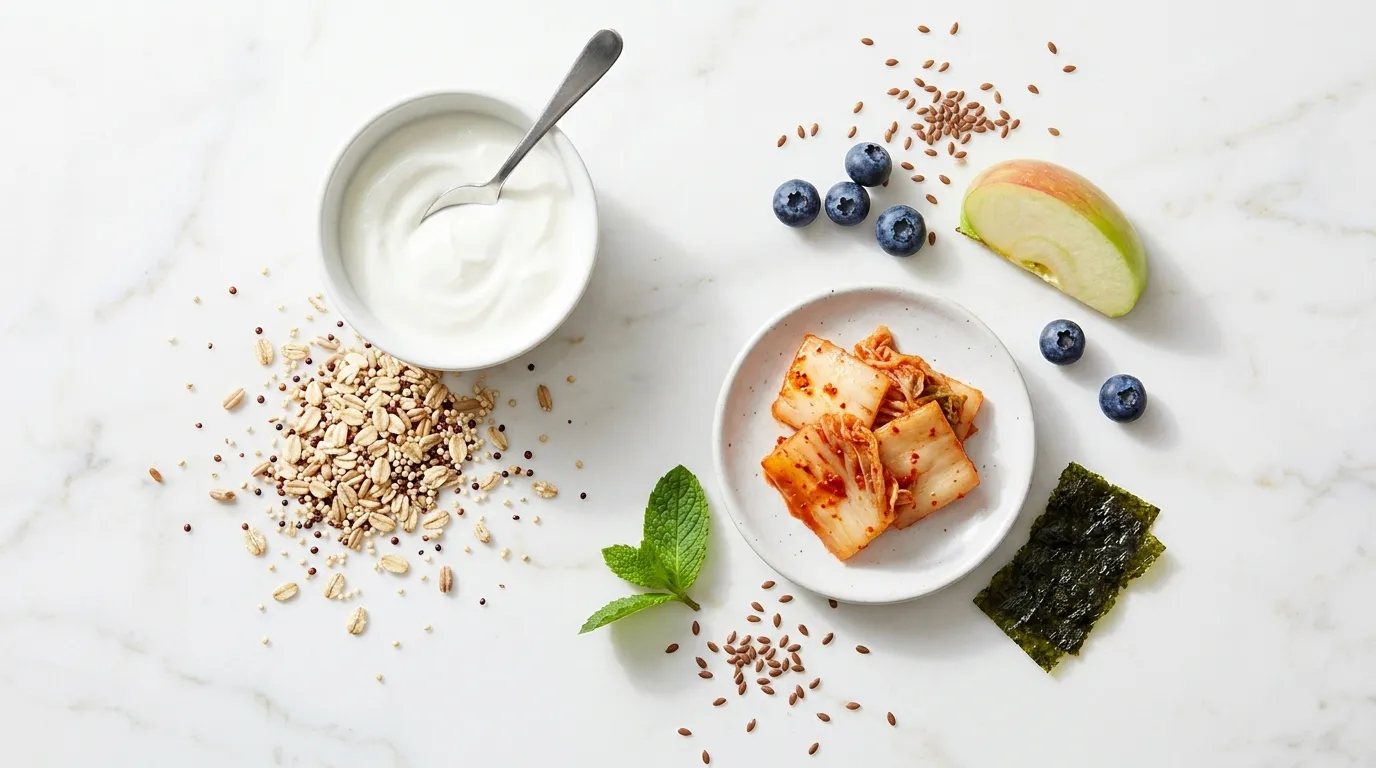
By Laura Collins | Updated July 2026 | 9 min read
This content is for informational purposes only and is not medical advice. Always consult your doctor about digestive symptoms that are persistent or severe.
Gut health has become one of the most talked-about topics in wellness — and unlike a lot of trending health advice, the science behind it is genuinely solid and still growing quickly. Your gut is home to trillions of bacteria that affect everything from digestion to mood to how efficiently your body processes sugar.
The good news: you don’t need an expensive supplement or a complicated protocol to start supporting it. These 7 foods have real, published research behind them — and most are already in your grocery store.
For a closer look at how gut health connects to blood sugar specifically, see our full product breakdown below.
🌿 GutOptim — Synbiotic Gut Health Formula
Combines probiotics with prebiotic fiber and gut-lining support ingredients. 60-day money-back guarantee, free shipping on all packages.
Read Our Full GutOptim Review →Why Gut Health Matters More Than You’d Think
Your gut microbiome — the community of bacteria living in your digestive tract — does more than just help you digest food. A 2026 review in Nature Reviews Microbiology describes it as central to immune function and metabolic resilience, with new research increasingly connecting gut bacteria to mood regulation, inflammation, and even blood sugar responses to specific foods.
A landmark 2025 study published in Nature Communications found that your gut microbiome can actually predict how your blood sugar will respond to different types of fiber — meaning gut health and blood sugar management are more connected than most people realize.
1. Fermented Foods (Yogurt, Kefir, Kimchi, Sauerkraut)
Fermented foods are created when bacteria, yeasts, or molds break down natural sugars in food — producing beneficial compounds along the way, including live probiotic bacteria that directly support your gut.
What the research shows:
A comprehensive 2025 study compared high-fiber diets to fermented-food-rich diets over 8 weeks. The fiber group saw increased digestive enzyme activity but minimal changes to gut bacteria diversity. The fermented food group — which increased intake to roughly 6 servings per day — saw a genuine increase in gut microbial diversity, along with reduced inflammatory markers.
How to use it: Plain Greek yogurt, plain kefir, kimchi, sauerkraut, and miso are all accessible options. Look for labels stating “live and active cultures” — not all fermented foods retain live bacteria after processing (some pasteurized versions don’t).
2. Whole Grains
Switching from refined grains (white rice, white bread) to whole grains (brown rice, quinoa, whole wheat) is one of the simplest, most evidence-backed changes for gut health.
What the research shows:
A randomized controlled crossover trial involving 50 overweight adults found that a whole-grain-rich diet significantly increased beneficial short-chain fatty acids in the gut — specifically butyrate and caproate — compared to a refined-grain diet. These increases were linked to higher activity from beneficial bacteria strains, including Faecalibacterium and Roseburia, both associated with reduced inflammation.
How to use it: Simple swaps make the biggest difference — brown rice instead of white, whole grain bread instead of white bread, quinoa or oats as a base for meals.
3. High-Fiber Fruits and Vegetables
Fiber is the primary fuel source for your beneficial gut bacteria — and most adults don’t get nearly enough of it.
What the research shows:
A 2024 editorial review in Frontiers in Nutrition, synthesizing eight separate studies, confirmed that fruits and vegetables regulate gut microbiome composition through their fiber content, supporting the growth of prebiotic, probiotic, and postbiotic pathways simultaneously.
Apples, pears, berries, leafy greens, and legumes are particularly rich sources of the specific fiber types your gut bacteria prefer to ferment.
How to use it: Aim for a variety of colors and types rather than relying on just one or two sources — different fiber types feed different beneficial bacterial strains.
4. Flaxseed
Flaxseed provides both prebiotic fiber and anti-inflammatory omega-3 fatty acids, giving it a dual mechanism for gut support.
What it does: The mucilage fiber in flaxseed soothes the digestive lining and feeds beneficial Bifidobacterium strains, while the omega-3 content supports reduced gut inflammation.
How to use it: Ground flaxseed (not whole) is more digestible and easier for your body to access the nutrients from. Add a tablespoon to oatmeal, yogurt, or smoothies.
5. Legumes (Beans, Lentils, Chickpeas)
Legumes contain resistant starch — a type of carbohydrate that resists digestion in the small intestine and instead ferments in the colon, directly feeding beneficial bacteria.
What the research shows:
Research on fiber and the gut microbiome consistently identifies legumes as one of the most effective food categories for increasing beneficial short-chain fatty acid production, which supports gut lining integrity and reduces inflammation throughout the digestive tract.
How to use it: Half a cup of beans or lentils several times a week, added to soups, salads, or as a side dish.
6. Prunes
Prunes are one of the most specifically studied foods for digestive regularity — and the evidence extends beyond just their well-known effect on constipation.
What it does: Rich in sorbitol and insoluble fiber that increase gut motility, plus polyphenols with prebiotic properties that support beneficial bacteria growth.
How to use it: A small handful (4-5 prunes) as a snack, or chopped into oatmeal.
7. Seaweed
An emerging area of gut health research, seaweed functions as a natural prebiotic fiber source while also contributing trace minerals.
What the research shows:
Clinical studies from 2024 to 2026 have linked regular seaweed intake to modest improvements in body weight, cholesterol, and fat mass over 8 to 12 weeks of consistent consumption — alongside its established prebiotic fiber benefits for gut bacteria.
An important caution: Not all seaweed is equal for regular use. Kelp and kombu are high in iodine and can exceed safe intake levels with frequent consumption. Nori and wakame are lower-iodine options better suited for regular use.
How to use it: Nori sheets (the kind used for sushi) or wakame added to soups are accessible, low-iodine options for regular consumption.
The Gut-Blood Sugar Connection
One of the more significant recent research developments: a 2025 study published in Nature Communications found that individual gut microbiome composition can predict how a person’s blood sugar will respond to different dietary fibers — meaning the same fiber-rich meal can produce different blood sugar responses in different people, depending on their gut bacteria.
This helps explain why gut health and blood sugar management are increasingly discussed together rather than as separate topics. A healthier, more diverse gut microbiome appears to support more stable, predictable blood sugar responses to food.
For more on this connection: → How to Lower Blood Sugar Naturally → GutOptim Ingredients Explained
Building These Foods Into Your Week
You don’t need to eat all 7 every day. A practical approach:
Daily: A serving of high-fiber fruits or vegetables, whole grains as your base carbohydrate
Most days: A fermented food (yogurt, kefir, or a small serving of kimchi/sauerkraut)
3-4 times per week: Legumes as a side dish or added to soups/salads
A few times per week: Flaxseed added to breakfast, prunes as a snack
Occasionally: Low-iodine seaweed (nori, wakame) in soups or as a snack
Consistency over weeks and months matters more than any single meal — gut microbiome changes happen gradually as beneficial bacteria populations shift and stabilize.
When Diet Isn’t Quite Enough
For many people, consistent dietary changes produce real improvement in digestion, bloating, and regularity. But gut health involves a genuinely complex ecosystem, and some people benefit from additional support — particularly a synbiotic approach that combines probiotics with the prebiotic fiber they need to thrive.
🌿 GutOptim — Synbiotic Gut Health Formula
Combines probiotics with prebiotic fiber and gut-lining support ingredients. 60-day money-back guarantee, free shipping on all packages.
Try GutOptim — Official Website →Frequently Asked Questions
What foods are best for gut health? Fermented foods (yogurt, kefir, kimchi), whole grains, high-fiber fruits and vegetables, flaxseed, legumes, prunes, and seaweed all have real published research supporting gut microbiome health through different but complementary mechanisms.
How long does it take to improve gut health through diet? Meaningful changes in gut bacteria composition typically take several weeks of consistent dietary changes. Some effects, like improved regularity from fiber and fermented foods, can appear within days, while broader microbiome diversity changes build over weeks to months.
Are fermented foods better than fiber for gut health? Recent research suggests they work through different mechanisms and both matter. One 2025 study found fermented foods increased microbial diversity more directly, while fiber intake supported different fermentation pathways — the combination appears more effective than either alone.
Is seaweed good for gut health? Yes — seaweed functions as a natural prebiotic fiber source. However, iodine-rich varieties like kelp and kombu should be used in moderation; nori and wakame are better choices for frequent consumption.
Does gut health affect blood sugar? Yes, increasingly research confirms this connection. A 2025 study found that individual gut microbiome composition helps predict how a person’s blood sugar responds to specific dietary fibers — supporting the idea that gut health and blood sugar management are closely linked.
Read More on Wellness Balance Pro
→ GutOptim Review: Does It Actually Work for Gut Health? → GutOptim Ingredients Explained → 7 Superfoods Diabetics Should Eat Every Week → How to Lower Blood Sugar Naturally
This article is for informational and educational purposes only. It does not constitute medical advice. Always consult a licensed healthcare professional for personalized dietary guidance.